

doodlelecture
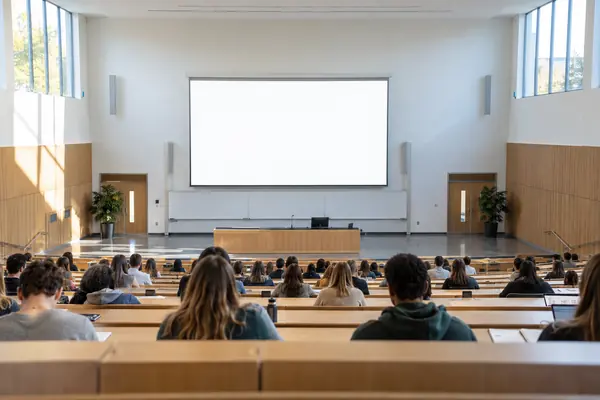
A large tiered lecture theatre seen from the back row, students at a distance facing a bright screen at the front
AI-generated image, not a photograph of a real person or place.

WHAT THE RESEARCH SAYS

Ask, don't
just tell.

A lecture works best when the room has something to do.

A review of 225 studies found students in lecture-only courses failed more often than those in courses with active learning. Other popular beliefs, like the 15-minute attention limit, have far thinner evidence behind them.

225 STUDIES on active learning

Check a claim

THE SHORT ANSWER

Less monologue,
more thinking aloud.

Three findings worth knowing
before the next lecture starts.

ATTENTION

The 15-minute rule is folklore

A 2016 review in Advances in Physiology Education found the available primary data do not support a 10- to 15-minute attention limit. The biggest variation in attention came from differences between teachers.

Where the myth came from


NOTES

Pen or laptop matters less

A 2021 direct replication found laptop note-takers did not perform worse on a quiz than longhand note-takers, though their notes contained more verbatim wording.

Check the claims

ACTIVE LEARNING

Ask, don't tell

Across 225 studies of undergraduate science teaching, active learning raised exam performance by about 6 percent on average and cut failure rates.

See the numbers
Students in a lecture theatre turned towards each other in pairs to talk through a question, seen from behind
AI-generated image, not a photograph of a real person or place.

FOUR HABITS FOR THE NEXT LECTURE

Make the hour
do more work.

These come straight from the studies above and The Learning Scientists' reading of them. They work whether you write by hand or type.

  1. Read before you arrive

    In active-learning courses, students read the material before class and short quizzes check their preparation.

  2. Capture ideas, not transcripts

    Notes that overlap with what you will be tested on matter more than whether they are typed or handwritten.

  3. Review your notes afterwards

    Studying the notes before a test further reduced the differences between note-taking methods.

  4. Answer the questions in the room

    Whether by clicker, show of hands or a word with a neighbour, answering in-class questions is retrieval practice.

TWO NUMBERS WORTH KNOWING

Small change in method,
big change in results.

From the 2014 review of 225 studies
of undergraduate science, engineering and maths teaching.

34 → 22

Students failing, out of every 100

Explaining the review, its lead author said that of 100 students, about 34 fail if they get lectured to but only 22 fail if they do active learning.

FAILURE · FREEMAN ET AL.

≈ 6%

Average rise in exam performance

Active learning raised exam performance by an average of 6 percent, which the University of Washington said would move a grade up about half a letter.

EXAM SCORES · FREEMAN ET AL.

Active learning here means students take part in discussion and problem-solving: reading before class, answering questions with clickers, or thinking and discussing before being called on at random.

A QUICK MYTH CHECK

How well does the
evidence hold up?

Pick a common belief about lectures to see what the research found. The bar shows how strongly the studies below support the claim.

Claim check

Choose a claim
Attention runs out after 10 to 15 minutesWeak support

Bradbury traced most citations back to a single 1978 review and concluded the primary data do not support a 10- to 15-minute limit.

Handwritten notes always beat laptop notesMixed results

Urry and colleagues found laptop note-takers did not score lower on a quiz. Morehead's team found a longhand edge on factual questions only, and no effect on a delayed test.

Fuller notes go with better recallSome support

In mini meta-analyses of similar studies, a higher word count in notes was associated with better quiz performance.

Active learning beats pure lecturingStrong support

A review of 225 studies found exam performance rose by about 6 percent on average, and failure rates fell from roughly a third to about a fifth.

Sources: Bradbury, Advances in Physiology Education (2016); Urry et al., Psychological Science (2021); The Learning Scientists (2019); University of Washington News (2014).

Based on Bradbury (2016), Urry et al. (2021), Morehead, Dunlosky and Rawson (2019) as summarised by The Learning Scientists, and Freeman et al. (2014) as reported by the University of Washington.

A student's hands writing notes in a paper notebook beside an open laptop on a lecture theatre desk
AI-generated image, not a photograph of a real person or place.

WHERE THE MYTH CAME FROM

A number repeated
until it felt true.

Bradbury found that claims of attention waning at 10 to 15 minutes mostly trace back to one 1978 review. In one early study he examined, observers attended lectures together only 13% of the time, and 87% of the data came from a single observer.

Another study he discusses had students rate their own attention every 5 minutes in 50-minute lectures: it rose over the first 10 to 20 minutes, then declined slowly without falling below its starting level. His conclusion is that improving teaching matters more than cutting lectures short.

Questions

Questions people ask

Do students really switch off after 15 minutes?

The evidence is thin. A 2016 review by Neil Bradbury concluded that the available primary data do not support the concept of a 10- to 15-minute attention limit, and that differences between teachers explain the most variation.

Should I take notes by hand or on a laptop?

A 2021 direct replication found laptop note-takers did not do worse on a quiz than longhand note-takers. A 2019 replication found a longhand advantage only on factual questions, and none on a delayed test.

What is active learning?

Teaching that expects students to take part in discussions and problem-solving beyond what they have memorised, such as answering clicker questions or discussing a problem before being called on.

How big is the difference active learning makes?

A review of 225 studies found exam performance rose by an average of 6 percent, and roughly a third of students in lecture courses failed compared with about a fifth with active learning.

Does it help to review notes after a lecture?

In the 2019 replication summarised by The Learning Scientists, studying the notes before a test further reduced differences between note-taking methods.

Sources

  1. University of Washington News: Improve grades, reduce failure (Freeman et al., 2014)
  2. Bradbury (2016), Attention span during lectures: 8 seconds, 10 minutes, or more? Advances in Physiology Education (PDF)
  3. Urry et al. (2021), Don't Ditch the Laptop Just Yet, Psychological Science
  4. The Learning Scientists: New findings inform the laptop versus longhand note-taking debate

Updated

ABOUT THIS NAME

Interested in leasing doodlelecture.com?

doodlelecture.com is part of the DoodleSale portfolio. It isn't in an auction right now, but you can ask about leasing it.

Ask about this name